Posts

Showing posts with the label SOIL RESISTIVITY TESTING

Wenner Method For Earth resistivity Test | Methodology , Application and Benefits

Image
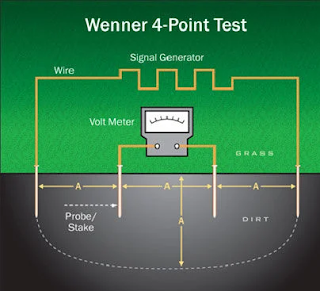
Wenner method for earth resistivity test The Wenner method is a technique used in geophysics for measuring the electrical resistivity of subsurface materials. It is named after Frank Wenner, who developed the method in the early 20th century. Equipment : Typically, the equipment includes a resistivity meter, cables, and four electrodes. The electrodes are placed in a specific configuration depending on the method used (e.g., Wenner, Schlumberger, or dipole-dipole). Soil Resistivity test using Resistivity meter   Visit https://bhoojalsurvey.in/ for more details  Here’s how the Wenner method works for earth resistivity testing : Setup : Four electrodes are placed in a straight line with equal spacing (usually denoted as ‘a’). The electrodes are labeled as A, B, M, and N. Electrical Current : A known electrical current (I) is passed through electrodes  A and B. Voltage Measurement : The potential difference (V) between electrodes M and N is measured. Calculatio...
What is Earth Resistivity Testing, and Why is it Important?

Do you know that with an Earth Resistivity Test, you could unearth the secrets of the Earth? This potent method carries immense value as it offers indispensable knowledge about soil composition and its electrical conductivity. Earth Resistivity Test is an advanced geophysical survey method that facilitates a more profound comprehension of the terrain beneath our feet. Considering the importance of this test, this all-inclusive guide strives to illuminate the importance of technique. As well as delve into its various applications and emphasize its significance in activities such as site characterization, geological mapping, and groundwater exploration. Let's go through the guide… A geophysical technique called Earth Resistivity Testing helps determine how permeable the ground is to electrical currents. The process of Earth Resistivity Testing involves passing a controlled amount of current through the soil and then measuring the resulting voltage. The value obtained is used to comp...

What is Soil Resistivity Test?

Image
Soil resistivity test is conducted to measure the resistance of soil when current is passed through it. It is a critical factor in design of systems that rely on passing current through the Earth's surface. Soil resistivity is the ability of the soil to resist the flow of electricity. Various factors affect the resistivity of a soil such as its composition, temperature and moisture content. Since soil is not a homogenous substance, its resistivity will vary with depth, with lower soil layers having greater moisture content and hence lower resistivity. For hard and rocky soil, the resistivity increases with depth. Bhoojal Survey has successfully conducted Soil resistivity test operations at different sites across India using wenner method. For queries visit https://bhoojalsurvey.in/soil-resistivity-test.php Soil resistivity testing has multiple purposes 1) Soil resistivity test is conducted to determine Low resistivity zone for safe earthing purposes. It is most effective way to id...